
Knoxville, TN

Window Flashing Installation in Knoxville, TN

Family Owned& Operated
20+Years in East Tennessee
Licensed Home Improvement ContractorWC & Liability Insured
East TNKnoxville and surrounding areas

Flashing is the part of a window installation nobody sees and almost nobody asks about — and it is the part that decides whether the wall behind the window stays dry. This page explains what it is, how it is supposed to work, how it fails, and what correcting it involves.

Closely related work: window caulking and sealing, aluminum window wrap and capping, and energy-efficient windows.

Proper flashing is one of the most important parts of any window installation.

Without it, water can enter behind the siding and cause serious damage to your home.

At MI Homesiding & Roofing, we provide professional window flashing installation in Knoxville, TN, helping homeowners protect their homes from leaks, moisture damage, and long-term structural issues.

Over more than 20 years we have worked on many homes where the windows were installed correctly on the surface but failed behind the wall, because the flashing was never installed at all.

Our goal is to ensure every window is properly integrated into the home’s exterior system.

Posted on Google Google
Dan Hopp profile picture
Dan Hopp
Google star 1Google star 2Google star 3Google star 4Google star 5Trustindex verifies that the original source of the review is Google.
Had a fascia bit replaced. That was one of the fastest, cleanest jobs
Posted on Google Google
Richard profile picture
Richard
Google star 1Google star 2Google star 3Google star 4Google star 5Trustindex verifies that the original source of the review is Google.
Thanks for the great work! Quick, fair price, professional and friendly. Highly recommend.
Posted on Google Google
Andreas Enns profile picture
Andreas Enns
Google star 1Google star 2Google star 3Google star 4Google star 5Trustindex verifies that the original source of the review is Google.
The guys were very responsive and did a great job!
Posted on Google Google
Lauren Senesac Nichols profile picture
Lauren Senesac Nichols
Google star 1Google star 2Google star 3Google star 4Google star 5Trustindex verifies that the original source of the review is Google.
Mel was so easy to work with. We had him out because we needed to figure out how to fix a roof leak where the flashing wasn't done right (and part of the siding was also not right). He did a thorough inspection and explained to me what issues he saw. His quote was similar to the other we got. We ended up having him put on a new roof, with a new under shingle ventilation system and a roof vent. He also corrected siding issues (and flashing), fixed some rotten trim, and repainted part of the siding and trim. Everything looks great! His crews were very nice. Of all the contractors we've worked with on various renovations, Mel was easily one of the best at quickly responding when we had a question or saw an issue we wanted handled differently. We'll definitely hire him again if we need roof or siding work!
Posted on Google Google
James Keller profile picture
James Keller
Google star 1Google star 2Google star 3Google star 4Google star 5Trustindex verifies that the original source of the review is Google.
Mel and his team were extremely thorough in identifying and correcting a water leakage problem from the top of our deck into the enclosed sun room below. They were both professional and courteous and provided great follow up after the job was completed. I highly recommend MI Homesiding & Roofing for any problem that involves water leakage into your home. I will definitely use MI in the future.
Posted on Google Google
Laura Romans profile picture
Laura Romans
Google star 1Google star 2Google star 3Google star 4Google star 5Trustindex verifies that the original source of the review is Google.
Highly recommend MI Homesiding! They completed a major home exterior project for us including replacing and painting our siding as well as replacing our roofing and gutters. They did an excellent job and we began getting compliments immediately from our neighbors about it! Mel was very communicative and proactive, listened to our questions and ideas, and took care of things in a timely manner. His team was always professional and the work is just superb! We not only recommend MI Homesiding, we will be using them again for future projects ourselves.
Posted on Google Google
Ricardas Lukosiunas profile picture
Ricardas Lukosiunas
Google star 1Google star 2Google star 3Google star 4Google star 5Trustindex verifies that the original source of the review is Google.
I found MI Homesiding & Roofing through their YouTube channel and called with a few questions about siding. Even though I’m not located in Tennessee and wouldn’t be hiring them directly, they answered the phone right away and took the time to answer every question in detail. They provided specific, helpful information and even assisted me in finding a contractor in my area. It’s rare to find a company so willing to help someone who isn’t even a local customer. Awesome people, excellent service, and truly knowledgeable. Thank you so much!
Posted on Google Google
Jeff Nelden profile picture
Jeff Nelden
Google star 1Google star 2Google star 3Google star 4Google star 5Trustindex verifies that the original source of the review is Google.
Exceptionally pleased with entire process and results. Most professional estimate I received, good communication, timely, and did what they said they would. Building looks exceptional. I highly recommend Mel and his crew,

Verified credentials

Who you are actually hiring, and who stands behind the work.

  • True Metal Supply brand mark

    True Metal Supply

    Metal roofing and siding supplier

  • BBB Accredited Business badge

    BBB Accredited Business — A+ Rating

    Verify on bbb.org

  • TN #13334Licensed & Insured

    Licensed Home Improvement Contractor

    Tennessee license #13334 · General Liability and Workers’ Compensation insured

  • Knoxville Chamber Investor badge

    Knoxville Chamber Investor

    Investor member of the Knoxville Chamber

What Is Window Flashing and Why It Matters

Window flashing is a system of materials designed to direct water away from the window opening.

It never works alone. Flashing is one layer in an assembly that also includes:

Together those layers are meant to carry water back out to the face of the wall instead of letting it reach the sheathing and framing. Without flashing that is correctly placed and correctly lapped, water gets trapped behind the siding and causes damage that stays hidden for a long time.
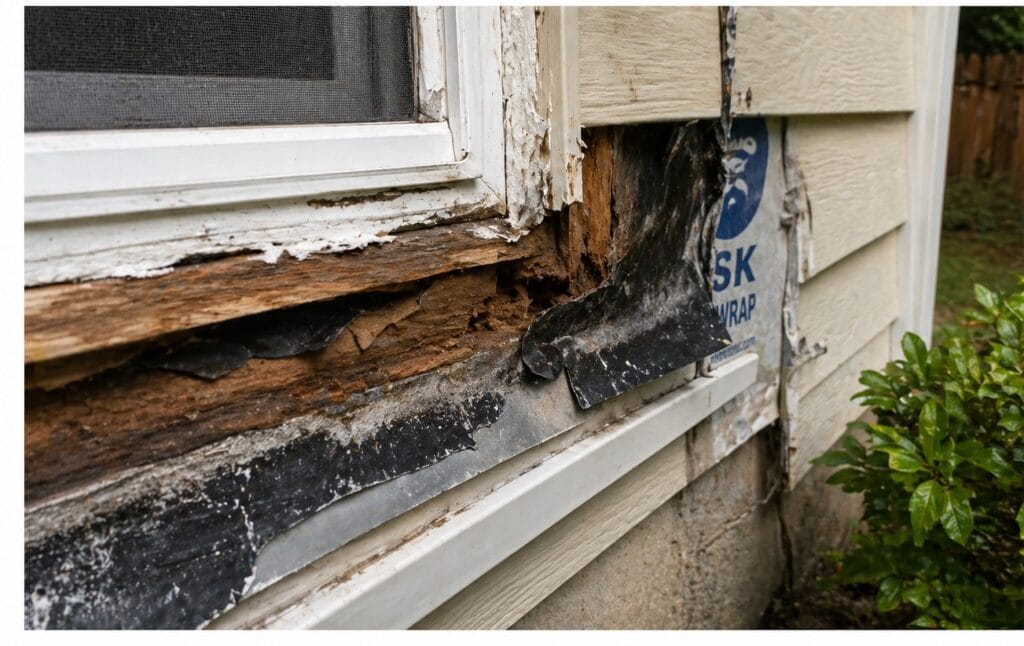
Window frame with wood rot and failed flashing exposed during repair in Knoxville, TN
01

house wrap

03

sealants

04

drainage systems

How Water Is Supposed to Move Around a Window Opening

The useful thing to understand about a wall is that it is not expected to be perfectly sealed. It is expected to drain. Siding is the first line, but some water always gets past it — through joints, around fasteners, driven by wind. What keeps the house dry is what happens to that water next.

The 2018 International Residential Code sets this out directly. It requires a water-resistive barrier behind the exterior cladding, and it requires the wall assembly to provide a means of draining to the exterior the water that gets past the cladding. Flashing at window and door openings is what makes that drainage work where the wall is interrupted.

  1. Water reaches the wall and runs down the face of the siding.
  2. Some gets behind the siding. This is normal and expected.
  3. It lands on the weather barrier and keeps running down.
  4. At the window, flashing catches it and directs it back out over the face of the cladding below.
  5. It leaves the wall instead of reaching the sheathing and framing.

Every flashing detail exists to serve that one sequence. When a window leaks, it is usually because the sequence was broken somewhere — not because the wall was insufficiently sealed.

Sill, Jamb and Head: What Each One Does

Flashing at a window is not one piece. It is three positions, each with a different job, and each depending on the one before it.

Sill — the bottom

Goes in first, before the window. Its job is to catch anything that gets into the opening and carry it back out. A missing sill detail is the classic reason a window leaks with no visible damage outside at all.

Jambs — the sides

Go in next, lapping over the sill detail so water running down the side of the opening is handed onto it rather than behind it.

Head — the top

Goes in last, lapping over the jambs and tucking under the barrier above. This is the piece most often missing entirely, and the one that matters most, because everything above the window drains through it.

That order — sill, then jambs, then head — is the point. The same materials installed in the wrong order will route water into the wall as efficiently as the right order routes it out.

The specific materials, widths and lap dimensions are not universal. They come from the installation instructions for the particular window and flashing products on your wall, and from the manufacturer’s own details. We work from those documents rather than applying one number to every house.

How Flashing Ties Into the Weather Barrier

Flashing and the weather-resistive barrier are not two separate products that happen to be near each other. They have to become one continuous surface that water can run down without finding a way behind it.

The barrier — house wrap, building felt or a coated sheathing — covers the wall. At the window, it has to be cut and folded into the opening and then connected to the flashing so that the two overlap in the draining direction. Get that connection right and the opening is just another part of the drainage plane. Get it wrong and the opening becomes the one place where water can get behind the barrier.

Continuity

The barrier has to be unbroken around the opening. Cut short, torn during siding work, or never folded in, it leaves a gap exactly where water concentrates.

Direction of lap

Upper layers over lower layers, always. Barrier over flashing in one place and under it in another is what creates a path inward.

Self-adhered membranes

Where a self-adhered membrane serves as the flashing, the code points to AAMA 711 as the standard it must comply with.

Corrosion resistance

The code calls for approved corrosion-resistant flashing at exterior window and door openings — the material has to survive being wet for the life of the wall.

Installation practice for exterior windows and doors is also addressed by the industry standard ASTM E2112, Standard Practice for Installation of Exterior Windows, Doors and Skylights. Where a manufacturer’s instructions and a standard both apply, the product instructions govern the installation of that product.

What “Shingle-Fashion” Actually Means

This is the phrase the code uses, and it is worth knowing because it explains almost every flashing failure in one idea.

Think about roof shingles. Each course overlaps the one below it, so water running down the roof always lands on top of the next piece and keeps going. Nothing is sealed. The overlapping alone is what sheds the water.

A wall works the same way. The 2018 IRC requires flashing to be applied shingle-fashion at exterior window and door openings, in a manner that prevents entry of water into the wall cavity, and to extend to the surface of the exterior wall finish. In practice that means every layer laps over the layer below it, in the direction water travels — down and out.

Reverse a single lap and the detail works backwards. Head flashing tucked on top of the barrier instead of underneath it will collect water and deliver it into the wall, even though every piece is present and every piece is the correct product. This is why flashing problems are so often invisible: nothing looks wrong from outside.

Common Flashing Problems we see in Knoxville Homes

After working on homes across Knoxville, We have seen many serious issues caused by missing or incorrect flashing.

No Flashing Installed

Some windows are installed without any flashing at all.

This allows water to enter directly behind the window and into the wall structure.

Improper Flashing Installation

Flashing must be installed in a specific sequence to work correctly.

If installed incorrectly, it can actually trap water instead of directing it away.

Missing Integration with House Wrap

Flashing should be integrated with the home’s house wrap to create a continuous drainage plane.

If this step is skipped, water can bypass the flashing system.

Over-Reliance on Caulking

Some installers rely only on caulking instead of proper flashing.

Caulking can fail over time, especially in Tennessee’s heat and humidity.

Flashing provides long-term protection that caulking alone cannot.
MI Homesiding crew member at the rear entry of a Knoxville, TN home

Caulk Is Not a Substitute for Flashing

Sealant has a legitimate place in a window assembly. It closes joints that are meant to be closed, it keeps air out, and when the sealant itself is what failed, renewing it is the right repair.

What it cannot do is replace the drainage system. Flashing and the weather barrier work by geometry — overlapping layers that keep working whether or not anything sticks. Sealant works by adhesion, and adhesion is a consumable: it ages, it shrinks, it moves with the building, and eventually it lets go. A detail that depends on sealant alone has a service life rather than a design.

So when a window is re-caulked and leaks again the following spring, that is usually not bad caulk. It is a flashing problem that caulk was asked to solve.

Diagnosing which one you actually have is covered on our window leak repair page.

How Flashing Fails

These are the patterns we find most often once an opening is exposed. Not every window leak is caused by one of them — leaks also come from the roof, the gutters, the siding above, or a failed glass seal — but when the cause is at the opening, it is usually on this list.

No head flashing

Nothing at all above the window, so everything draining down that part of the wall arrives at the top of the opening.

Membrane lapped the wrong way

All the pieces present, installed in an order that routes water inward. The most common genuinely hidden failure.

Wrong sequence against the barrier

Flashing over the barrier where it should be under it, or the reverse, breaking the continuity of the drainage plane.

Damaged membrane

Torn during siding installation, cut short at the corners, punctured by fasteners, or degraded by long UV exposure before the cladding went on.

Sealant used as the system

No flashing installed, with a bead of sealant doing the whole job until it stops.

Poor siding and trim transitions

Where the cladding meets the opening, and where two materials meet above it, the flashing has to carry across. Often it simply stops.

The last category is the hardest for a homeowner: concealed failure behind intact cladding. The siding looks fine, the trim looks fine, the sealant looks fresh, and the wall behind has been wet for years.

Signs Your Windows May Have Flashing Issues

Many homeowners don’t realize they have a flashing problem until damage appears.

Common warning signs include:

If you notice any of these issues, it’s important to inspect the window and surrounding wall system.

01

water stains around windows

02

mold or mildew near window frames

03

peeling paint or soft wood

04

leaks during heavy rain

05

drafts or air leaks

Our Window Flashing Installation Process

At MI Homesiding & Roofing, we follow a detailed process to ensure proper installation.

Inspection of the window and surrounding area
Identifying existing problems and moisture damage.

Removal of siding or trim if necessary
Accessing the full window opening.

Installation of flashing tape and materials
Creating a layered system that directs water away from the window.

Integration with house wrap and siding
Ensuring a continuous drainage plane.

Sealing and finishing
Protecting the window from both water and air infiltration.

Because we install siding as well as windows, the connection between the opening and the wall is part of our own scope rather than somebody else’s.

Getting to the Flashing: What Has to Come Off

Flashing sits behind the cladding. That single fact governs what a flashing repair involves, and it is the part homeowners are most often not told in advance. How much comes off depends on what has to be reached.

Exterior trim only

Sometimes enough to inspect and correct the detail at the head or the jambs, where the problem is at the perimeter.

Trim and siding

Needed when the flashing has to be re-lapped into the weather barrier, because that connection is behind the siding and cannot be made from the face of the wall.

The window unit

Where the sill detail is the problem. The sill goes in before the window, so correcting it properly can mean taking the window out and resetting it.

Interior finish

Where interior trim or drywall has been damaged, or where access from inside is needed. We complete the interior work that the approved scope includes.

We put the expected access in the written scope before starting. Where siding has to come off and go back, profile and color matching on older material is usually the practical constraint, and we say so up front rather than on the day.

What May Be Found Behind the Cladding

A flashing estimate is written from what can be seen. Once the trim or siding comes off, the opening tells the truth, and after a long-running flashing failure it is sometimes worse than the outside suggested.

Sheathing rot

Soft or crumbling board behind the siding, typically directly below or beside the opening.

Framing damage

Sill plate, trimmers or header affected where water has been sitting over several seasons.

Wet insulation

Saturated batt in the cavity, which stays wet long after the leak itself has been stopped.

Damaged weather barrier

Torn, cut short, or never lapped into the opening to begin with.

Insect damage

Wet wood attracts it, so it is frequently found alongside rot rather than on its own.

What happens next

We stop, photograph it, explain it, price it, and issue a written Change Order. You approve it before any additional work happens.

Concealed repair is not assumed in the original flashing estimate. Nobody can price what nobody can see, and pretending otherwise is how a quote becomes an argument.

Why Flashing Is Critical in Knoxville’s Climate

Knoxville experiences:

These conditions expose weaknesses in a poorly flashed opening faster than a milder climate would.
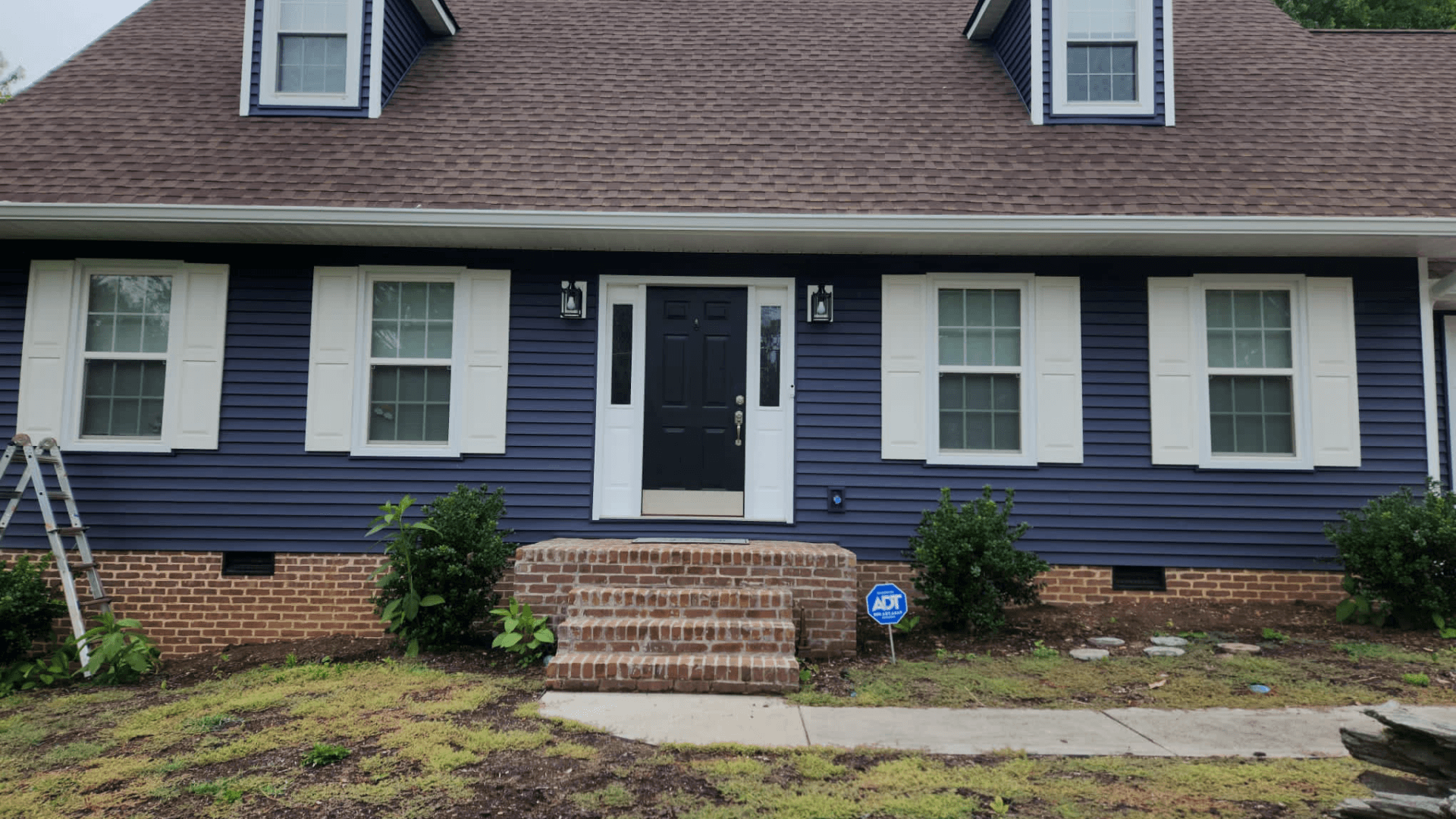
Navy blue Cape Cod home with white window trim and dormers in East Tennessee
01

heavy spring rains

02

high humidity

03

seasonal storms

04

temperature changes

Correctly installed and correctly lapped flashing is what lets the opening handle those conditions. It helps:

01

direct water back out of the wall

02

protect structural framing

03

reduce the conditions mold needs

04

support the service life of the window assembly

When Flashing Repair or Replacement Is Needed

Flashing may need to be repaired or replaced if:

In some cases, we can repair the flashing without replacing the entire window.

In other cases, window replacement may be necessary if damage is severe.

  • your windows are leaking

  • siding around windows is damaged

  • previous installation was done incorrectly

  • moisture damage is visible

Window set into cedar board and batten siding on a Knoxville, TN home

Localized Repair or Broader Reinstallation

There is no rule that settles this for every window. The opening does. These are the patterns that usually point one way or the other.

Localized repair may be possible when…

The failure is at one position — often the head — and the rest of the detail is sound. The weather barrier around the opening is intact enough to lap into. The window is properly set and undamaged. The surrounding structure is dry.

Broader removal and reinstallation when…

The sill detail is the problem and the window sits on top of it. The barrier around the opening is damaged beyond a patch. Several positions failed rather than one. Structural repair behind the opening has to happen before anything closes back up.

Which one applies is a judgment made at the opening, not from a photograph — and we would rather tell you it is the larger one before starting than discover it halfway through.

Warranty on Flashing Work

Repair and partial-repair scopes

Covered by a One (1) Year Limited Workmanship Warranty, subject to the signed agreement and the scope it defines.

Full replacement or reinstallation

Where the work becomes a full window installation or reinstallation, the Five (5) Year Limited Workmanship Warranty applies instead, according to the signed agreement.

Manufacturer warranties on the window and on the flashing products themselves vary by brand and product and are governed by those manufacturers. MI’s workmanship warranty applies separately to the scope described in the signed agreement.

Why Knoxville Homeowners Choose MI Homesiding & Roofing

At MI Homesiding & Roofing, we focus on doing the job correctly—not just quickly.

Homeowners work directly with the people doing the work, and every project is carefully inspected.

Our approach includes:

Many contractors install windows. Very few understand how to protect the home behind the wall.

Window frame with wood rot and failed flashing exposed during repair in Knoxville, TN
01

proper flashing systems (not shortcuts)

02

full exterior integration with siding

03

honest recommendations

04

experience for more than 20 years

Flashing Is Where Windows and Siding Meet

Flashing belongs to neither trade cleanly, which is exactly why it is so often the thing that was skipped. The window installer treats the wall as someone else’s, the siding crew treats the opening as someone else’s, and the lap between them never gets made. We do both sides of that wall, so the connection is nobody else’s problem.

Windows

The window replacement and installation page covers methods and scope. For a window that is already failing, see window repair, or leak diagnosis.

Siding

The siding overview, plus siding repair and siding replacement for the work around the opening.

When it has gone further

If water has been getting past the cladding for a while, see water behind siding.

Serving Knoxville and Nearby Communities

MI Homesiding & Roofing proudly provides window flashing installation in Knoxville TN and surrounding areas including:

If you suspect a problem with your window installation or flashing, we can inspect and repair it properly.

  • Farragut TN

  • Powell TN

  • Karns TN

  • Hardin Valley TN

  • Oak Ridge TN

Siding removed around windows exposing the weather barrier during exterior repair in East Tennessee

Schedule, Estimate and Warranty on Flashing Work

How long it takes. Single and multi-window replacements typically run about one day, and whole-house projects about two to four days. That is the normal expectation rather than a guarantee: the number of openings, access, how the wall is built, what we find once the old unit is out, and the weather all move it. The schedule goes in the written proposal.

What the written estimate itemizes. The number of openings and their sizes, the window line and series by name, the installation method for each opening — insert, full-frame or new-construction — flashing and weather barrier at every opening, interior and exterior finish, removal and disposal of the old units, and an allowance for what is found once the opening is bare. Where two window quotes differ sharply, the gap is almost always in the method and the flashing rather than in the glass.

Two warranties, kept separate. The manufacturer warrants the window; we warrant the installation. Our workmanship warranty runs five years on a full window installation or replacement and one year on a repair scope. Manufacturer coverage varies by product line and comes from the manufacturer, not from us.

Licensed Home Improvement Contractor (TN #13334) · City of Knoxville Building Contractor (#BC13334) · BBB Accredited with an A+ rating · Workers’ Compensation and General Liability carried · family owned and operated, bilingual English and Spanish · 20+ years of hands-on construction and exterior remodeling experience · Google Reviews.

Window Flashing FAQs

What is window flashing?

Window flashing is the set of overlapping materials installed around a window opening to catch water that gets behind the siding and direct it back out to the face of the wall. It is not a sealant and it is not one piece: it works at the sill, the jambs and the head, and it has to connect to the weather barrier behind the cladding.

What does window flashing do?

It keeps water moving down and out instead of into the wall. Siding is the first line, but some water always gets past it, and flashing is what makes sure the window opening drains rather than collects. Without it, water that gets behind the cladding reaches the sheathing and framing.

Do all windows need flashing?

Yes. The 2018 International Residential Code requires approved corrosion-resistant flashing at exterior window and door openings, applied shingle-fashion and extending to the surface of the exterior wall finish. The specific materials and details vary with the window, the cladding and the manufacturer instructions, but the requirement itself is not optional.

Is caulking enough to prevent leaks?

No, not on its own. Sealant closes joints and is a legitimate part of the assembly, but it works by adhesion, which ages and eventually lets go. Flashing works by overlapping geometry, which keeps working regardless. Where a detail depends on sealant alone, it has a service life rather than a design. Renewing sealant is the right repair only when the sealant itself is what failed.

Can missing flashing cause leaks?

Yes. Missing or incorrectly lapped flashing is one of the most common causes of water entering around a window. It is also one of the hardest for a homeowner to spot, because the siding, the trim and the sealant can all look perfectly sound while the wall behind them stays wet.

What is head flashing?

Head flashing is the detail at the top of the window opening. It goes in last, lapping over the jamb flashing and tucking under the weather barrier above, so that everything draining down that part of the wall is carried over the window rather than behind it. It is the piece most often missing altogether, and the one that matters most.

What is sill flashing?

Sill flashing is the detail at the bottom of the opening. It goes in first, before the window, and its job is to catch anything that gets into the opening and carry it back out. Because it is installed before the window, correcting a sill detail properly can mean removing and resetting the window.

How do the weather barrier and flashing work together?

They have to form one continuous surface. The barrier covers the wall and is folded into the opening; the flashing laps with it in the draining direction so there is no point where water can get behind both. If the barrier is cut short, torn or lapped the wrong way against the flashing, the opening becomes the one place in the wall where water can get past the drainage plane.

What does shingle-fashion mean?

It means each layer overlaps the one below it, the way roof shingles do, so water always lands on top of the next piece and keeps moving down and out. The 2018 IRC uses that term for how flashing must be applied at window and door openings. Reverse a single lap and the detail works backwards: every piece is present and correct, and water is still delivered into the wall.

Can flashing be repaired without replacing the window?

Often yes. Where the failure is at the head or the jambs and the window itself is sound and properly set, the flashing can usually be corrected without replacing the unit. Where the sill detail is the problem, the window sits on top of it, so correcting it properly may mean removing and resetting the window.

Do you have to remove siding to repair window flashing?

Frequently, yes. Flashing has to lap into the weather barrier, and that connection sits behind the cladding, so it cannot be made from the face of the wall with sealant. Sometimes removing the exterior trim is enough; often a section of siding has to come off and go back. We put the expected access in the written scope before starting.

What happens if there is rot behind the trim?

We stop. Rotted sheathing, framing damage, wet insulation, a damaged weather barrier and insect damage are not visible when the estimate is written. We photograph what we found, explain it, price it, and issue a written Change Order that you approve before any additional work happens.

Can water come from above the window?

Yes, and it is commonly missed. A roof-to-wall detail, a failed kickout, an overflowing gutter or a problem higher up the wall can deliver water that first becomes visible at the window simply because the opening is the easiest place for it to show. Tracing that is covered on our window leak repair page.

Ready to Get Started?

Tell us what you are seeing and we will take a look. Free estimates, clear pricing, and a licensed, insured crew that does what it says.

Call or Message for Prompt Assistance

MI Homesiding & Roofing is proud to serve Knoxville, TN, and surrounding communities with quality craftsmanship and dependable home improvement services.

Email

contact@mihomesidingllc.com

Location

Knoxville, TN