

MI Homesiding & Roofing
Knoxville, TN
Basement Window Replacement in Knoxville, TN
20+Years in East Tennessee
Family OwnedOwner-led inspections
East TNKnoxville and surrounding areas
Licensed Home Improvement ContractorWC & Liability Insured
Basement windows sit lower than any other window in the house, usually in masonry rather than framed wall, and often with water moving past them. That combination is why they fail differently from the windows upstairs — and why replacing one is as much about the opening as about the window.
In Knoxville, TN, the usual culprits are humidity, drainage that sends water toward the foundation, and openings that were never sealed properly in the first place.
At MI Homesiding & Roofing we replace basement windows and, just as often, tell homeowners that the window was never the problem.
For more than 20 years, I’ve worked on homes across East Tennessee and have seen plenty of basement windows fail — not because of the window itself, but because of water intrusion, poor sealing, or drainage that was never sorted out.
Related: window glass replacement, window leak repair, and window replacement and installation.
EXCELLENT Based on 64 reviews
 Posted on Google

 Dan HoppHad a fascia bit replaced. That was one of the fastest, cleanest jobsPosted on Google
 RichardThanks for the great work! Quick, fair price, professional and friendly. Highly recommend.Posted on Google
 Andreas EnnsThe guys were very responsive and did a great job!Posted on Google
 Lauren Senesac NicholsMel was so easy to work with. We had him out because we needed to figure out how to fix a roof leak where the flashing wasn't done right (and part of the siding was also not right). He did a thorough inspection and explained to me what issues he saw. His quote was similar to the other we got. We ended up having him put on a new roof, with a new under shingle ventilation system and a roof vent. He also corrected siding issues (and flashing), fixed some rotten trim, and repainted part of the siding and trim. Everything looks great! His crews were very nice. Of all the contractors we've worked with on various renovations, Mel was easily one of the best at quickly responding when we had a question or saw an issue we wanted handled differently. We'll definitely hire him again if we need roof or siding work!Posted on Google
 James KellerMel and his team were extremely thorough in identifying and correcting a water leakage problem from the top of our deck into the enclosed sun room below. They were both professional and courteous and provided great follow up after the job was completed. I highly recommend MI Homesiding & Roofing for any problem that involves water leakage into your home. I will definitely use MI in the future.Posted on Google
 Laura RomansHighly recommend MI Homesiding! They completed a major home exterior project for us including replacing and painting our siding as well as replacing our roofing and gutters. They did an excellent job and we began getting compliments immediately from our neighbors about it! Mel was very communicative and proactive, listened to our questions and ideas, and took care of things in a timely manner. His team was always professional and the work is just superb! We not only recommend MI Homesiding, we will be using them again for future projects ourselves.Posted on Google
 Ricardas LukosiunasI found MI Homesiding & Roofing through their YouTube channel and called with a few questions about siding. Even though I’m not located in Tennessee and wouldn’t be hiring them directly, they answered the phone right away and took the time to answer every question in detail. They provided specific, helpful information and even assisted me in finding a contractor in my area. It’s rare to find a company so willing to help someone who isn’t even a local customer. Awesome people, excellent service, and truly knowledgeable. Thank you so much!Posted on Google
 Jeff NeldenExceptionally pleased with entire process and results. Most professional estimate I received, good communication, timely, and did what they said they would. Building looks exceptional. I highly recommend Mel and his crew,Showing only 5 star reviews
Verified credentials
Who you are actually hiring, and who stands behind the work.

BBB Accredited Business — A+ Rating
- TN #13334Licensed & Insured
Licensed Home Improvement Contractor
Tennessee license #13334 · General Liability and Workers’ Compensation insured

Knoxville Chamber Investor
Investor member of the Knoxville Chamber


What Makes a Basement Window Different
A basement window is not simply a smaller version of the ones upstairs. Several conditions tend to apply at once, and they change what the work involves.
01
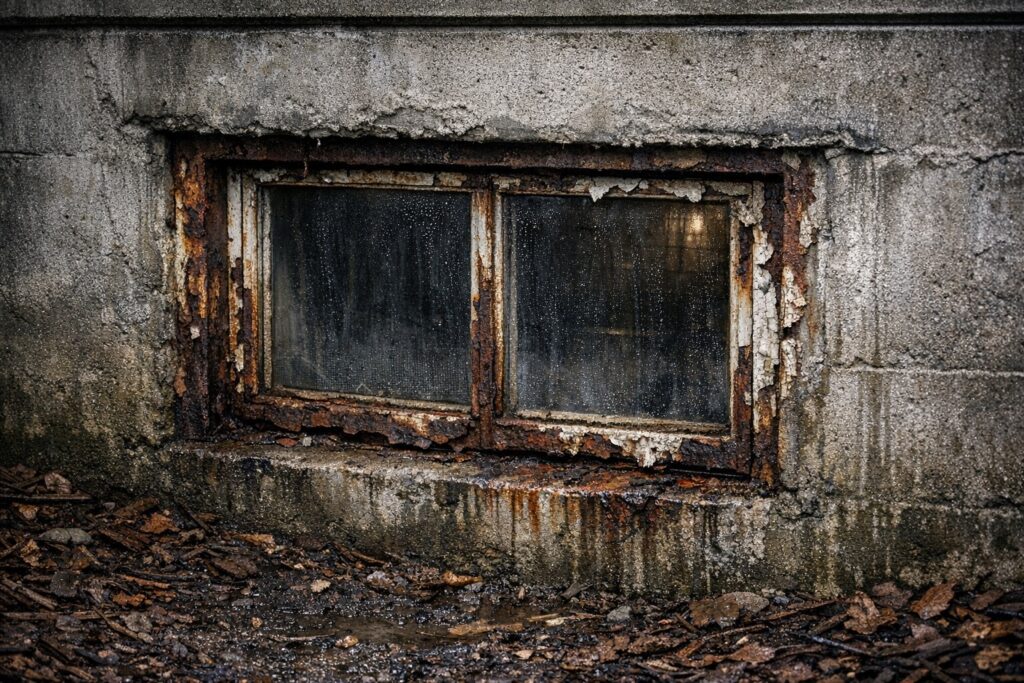
It sits low against grade. Often at or below the surrounding ground, which puts it in the path of water that is moving across or through the soil rather than falling on it.
02
The opening is usually masonry. Concrete block, poured concrete or stone, rather than a framed wall. The opening is part of the foundation, which changes how a window is anchored and sealed into it.
03
Moisture is constant. Higher humidity inside, damp soil outside, and less air movement than the rest of the house.
04
Access is restricted. Working from outside can mean working inside a window well, against a wall, or in a space with no room to stand back.
05
There may be a window well. Where there is one, it becomes part of the water story, and its condition matters as much as the window’s.
06
The opening is often old and small. Steel or wood units in sizes nobody makes any more, which affects what can be fitted back into it.
Not all basement windows are built the same way. A hopper in a block wall, a steel unit cast into poured concrete and a modern slider in a formed opening are three different jobs. Which one you have is established by looking at it.
Glass, Sash, Insert or Full-Frame?
“Replacing a basement window” can mean four different scopes. They are not interchangeable, and the opening usually decides which one is available.
01
Glass or insulated unit only. When the frame and opening are still in good condition, MI can replace the failed glass or insulated glass assembly without replacing the entire window frame, when the window design allows it. More on this under window glass replacement.
02
Sash replacement. Where the glass cannot be separated from the sash but the frame is sound and square, the sash is changed and the frame stays in the masonry. Depends on whether a sash is still available for that unit.
03
Insert or pocket replacement. A new window set into the existing frame, which stays in the opening. It needs that existing frame to be sound, square and properly anchored, and it gives up a little opening size.
04
Full-frame replacement. Everything comes out, down to the masonry opening. This is what is needed when the frame is gone, when there is rot or damage behind it, or when the opening itself has to be seen and dealt with. See window replacement and installation.
In a basement the balance tips toward full-frame more often than it does upstairs, for one reason: if water has been getting in, the only way to find out what it has done is to take the window out and look at the opening. An insert fitted over an unexamined problem hides it rather than fixing it.
Masonry and Concrete Openings
Most basement windows sit in an opening formed in the foundation rather than framed in lumber, and that changes the work in three ways.
What has to be established first:
what the opening actually is — concrete block, poured concrete, stone, or a wood buck set into masonry
the condition of that material: sound, cracked, spalling, previously patched, or wet
whether anything above the opening is carrying load, and how it is doing it
whether an earlier installation left a frame, shims or sealant that has to come out first
how the perimeter can be sealed so that water is managed rather than trapped
The method for anchoring and sealing follows from those answers and from the product going in. We do not publish fastener types, spacing or sealant dimensions on this page. Those belong to the actual substrate and to the manufacturer’s instructions for the specific window, and a figure printed on a website is the wrong place to get them.
One thing worth saying plainly: a perimeter seal is a water-management detail, not a dam. The aim is to close the gap properly and give any water that does reach it somewhere to go — not to claim the opening has been made impervious.
Why a Basement Window Leaks
This is the part that gets rushed, and it is the part that decides whether the money is well spent.
Water appearing at a basement window does not mean the window is the source. There are at least six possibilities, and they need different repairs:
01
The glass or sealed unit. A failed seal or a cracked pane. Genuinely the window, and the one case a new unit fixes.
02
The perimeter seal. Where the window meets the masonry. An open or failed joint lets water past the window without the window being faulty.
03
Flashing or an exterior water path. Water arriving from above — siding, trim or flashing — and running down behind the wall to the first opening it meets.
04
The window well. A well that fills up turns into a basin against the glass. Blocked drainage or packed debris does this long before the window does anything wrong.
05
Grading and drainage. Ground sloping back toward the house, a downspout discharging beside the foundation, or a gutter that overflows at that corner.
06
The foundation itself. Moisture moving through block or concrete, which shows up at the opening because that is where it becomes visible.
Replacing the window addresses the first two. It does nothing for the other four. That is the whole reason we look before quoting — a new window fitted into an opening that is being fed water from the grading will leak exactly as the old one did, and the homeowner will reasonably conclude the work was no good.
If the water is arriving rather than seeping, see window leak repair, which covers how a water path is traced.
Window Wells
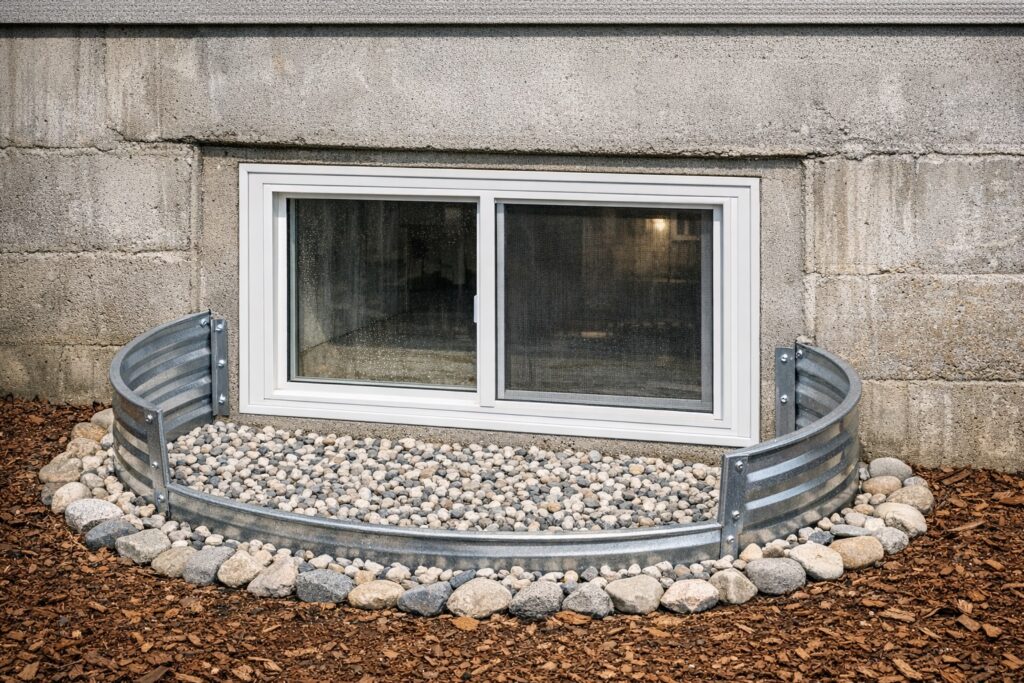
Where a basement window sits below grade, a well holds the earth back and lets light and air reach the opening. When it is working you never think about it. When it is not, it is often the actual cause of what looks like a window problem.
What we look at:
Condition — whether the well is sound and still fixed to the wall, or rusted, bowed or pulling away
Drainage — whether water that enters the well has a way out, or simply sits in it
Debris — leaves and silt that fill the gravel and turn a drain into a plug
Depth and clearance — how the well relates to the window and to the ground around it
Access — whether the window can actually be worked on, and whether a person could get out through it
We do not publish well dimensions here. Where a well relates to an escape opening, what it has to achieve is set by the applicable code for that property and project, and that is verified rather than assumed.
Egress and Emergency Escape
Some basement windows serve emergency escape or rescue functions. Whether a specific opening must meet egress requirements depends on the room, project and applicable code, so the requirement must be verified for the actual property and scope.
Three things worth understanding before anyone quotes you:
What matters about such an opening is the function — that a person can get out and a responder can get in — not the style of window fitted into it.
A replacement should not casually reduce a function the opening was serving. An insert fitted inside an existing frame, for instance, makes the clear opening slightly smaller, which is a detail worth knowing about before it is installed rather than afterwards.
And if the basement use is changing — a room being finished, a bedroom being added — that is exactly when the requirement needs checking for the actual project.
We do not publish egress dimensions on this page. Minimum widths, heights, clear opening areas, sill heights and well sizes are set by the code in force for your jurisdiction and your project, and the only number worth having is the one verified against that. Anyone quoting you a figure off the top of their head is guessing on your behalf.
Rot and Hidden Damage
Basement openings hide their damage better than most, because the wood that rots is usually behind trim, below grade, or both.
Where there is wood in or around the opening, this is what tends to be found once the old window is out:
rot in a wood buck, jamb or sill that was set into the masonry
damaged sheathing or framing where a wood wall meets the foundation
sealant and flashing from an earlier repair that failed years ago
previous patching that covered the problem rather than correcting it
None of that can be priced before it is seen, and we will not pretend otherwise. When we find it, the process is the same every time: document it with photos, explain what it is and why it matters, price the additional work, get your written approval, and only then proceed. That is the Hidden Damage Policy further down this page, and it is why nothing gets added to a job without a written Change Order.
Energy and Comfort
A basement window is a small part of the envelope, but it is often the leakiest part of a cold room. Four things determine what a new one does for you:
The rated numbers on the product — U-factor describes how well it insulates and SHGC how much solar heat it admits; both are published for the specific window
The glass and the frame — how many panes, any coating, and what the frame is made of
Air leakage — usually the one that is felt first in a basement, and the one an old steel unit is worst at
The installation — which no product rating covers, and which in a masonry opening is most of the job
We will not put a savings percentage on it. That would have to assume how your basement is used, what the rest of the house is doing and what you pay for energy. How the rated numbers actually work is covered on our energy-efficient windows page.
Our Basement Window Process
Eleven steps, and the first five happen before anything is ordered.
01
Inspect the window and the opening, inside and out, including the well where there is one.
02
Identify the opening construction — block, poured concrete, stone or a wood buck in masonry.
03
Assess moisture and damage, and work out where water is actually coming from before deciding anything.
04
Determine the route — glass, sash, insert or full-frame — based on what the opening will support.
05
Check egress considerations where the opening serves or may need to serve an escape function, verified for the project.
06
Measure and specify the product against that opening, not against a standard size.
07
Confirm the scope in writing with you before anything is ordered.
08
Remove the existing unit or component, and look at what is behind it.
09
Install and seal in the way the substrate and the product call for, with water managed rather than trapped.
10
Finish inside and out within the contracted scope.
11
Clean up and check it with you — operation, latch and the finished perimeter.
If step 3 or step 8 turns up something that was not visible from outside, the Hidden Damage Policy takes over and nothing proceeds without a written Change Order.
Workmanship Warranty
Which level applies depends on the scope of the work rather than on the product:
repair and partial work — One (1) Year Limited Workmanship Warranty
full window installation or replacement — Five (5) Year Limited Workmanship Warranty
Both are subject to a signed agreement and to the scope of work defined in it, and they cover our workmanship.
Any warranty on the window or the glass itself is the manufacturer’s, separate from ours, and its length and terms vary by brand and by model. We will tell you what comes with the unit being supplied for your opening rather than describing it in general terms here.
Why Knoxville Homeowners Choose MI Homesiding & Roofing
We work on the exterior as a system, which is the useful thing to have on a basement window: the problem is usually water, and water arrives from somewhere else.
01
the water path identified before the window is priced
02
flashing, drainage and siding understood as one assembly
03
what is found behind the trim documented with photos first
04
more than 20 years of hands-on construction and exterior remodeling experience
Homeowners work directly with me, and more than once the honest answer has been that the window was fine and the downspout was not.
Serving Knoxville and Nearby Communities
MI Homesiding & Roofing provides basement window replacement in Knoxville TN and the surrounding communities, including:
Farragut TN
Powell TN
Karns TN
Hardin Valley TN
Oak Ridge TN
If a basement window is leaking, rotted or no longer safe to rely on, we will tell you what is actually causing it — and if the window is not the problem, that is the answer you will get.
What a Basement Window Job Involves in Time and Scope
Basement openings sit in masonry or block more often than in framing, and that changes both the method and what the estimate has to account for.
How long it takes. Single and multi-window replacements typically run about one day, and whole-house projects about two to four days. That is the normal expectation rather than a guarantee: the number of openings, access, how the wall is built, what we find once the old unit is out, and the weather all move it. The schedule goes in the written proposal.
What the written estimate itemizes. The number of openings and their sizes, the window line and series by name, the installation method for each opening — insert, full-frame or new-construction — flashing and weather barrier at every opening, interior and exterior finish, removal and disposal of the old units, and an allowance for what is found once the opening is bare. Where two window quotes differ sharply, the gap is almost always in the method and the flashing rather than in the glass.
Two warranties, kept separate. The manufacturer warrants the window; we warrant the installation. Our workmanship warranty runs five years on a full window installation or replacement and one year on a repair scope. Manufacturer coverage varies by product line and comes from the manufacturer, not from us.
Licensed Home Improvement Contractor (TN #13334) · City of Knoxville Building Contractor (#BC13334) · BBB Accredited with an A+ rating · Workers’ Compensation and General Liability carried · family owned and operated, bilingual English and Spanish · 20+ years of hands-on construction and exterior remodeling experience · Google Reviews.
Basement Window FAQs
Can you replace a basement window without replacing the whole frame?
Often. When the frame and opening are still in good condition, MI can replace the failed glass or insulated glass assembly without replacing the entire window frame, when the window design allows it. In a basement the condition of the opening matters more than usual, because the masonry or concrete around it is doing the structural work. It is confirmed on site rather than assumed.
Can just the glass be replaced?
Sometimes. If the sash is serviceable and the product is built so the glass can come out, replacing the glass or the sealed unit on its own is an option. Older steel basement windows often are not built that way, and some have glazing that cannot be separated from the sash. Our window glass replacement page covers how that is decided.
Why is my basement window leaking?
Water showing up at a basement window does not mean the window is the source. It can be the glass or sealed unit, the perimeter seal where the window meets the opening, flashing or an exterior water path above it, a window well that is holding water, grading and drainage that send water toward the foundation, or moisture coming through the foundation itself. Those are six different repairs, so the source has to be identified before anything is replaced.
Does every basement window have to be an egress window?
No. Some basement windows serve emergency escape or rescue functions. Whether a specific opening must meet egress requirements depends on the room, project and applicable code, so the requirement must be verified for the actual property and scope. We do not publish dimensions on this page, because the requirement that applies to your basement is the one that has to be checked against the code in force for your jurisdiction and your project.
What is an egress window?
It is a window intended to serve as an emergency escape or rescue opening, so that someone can get out of the room and a responder can get in. The point of the opening is the function, not the style of window. Whether a particular room requires one, and what it has to achieve, depends on the applicable code and the project.
Can a basement window be installed in a masonry opening?
Yes, that is the common case. Basement openings are usually formed in concrete block, poured concrete or stone, and the method for anchoring and sealing the window depends on which of those it is and on the product going in. We do not publish fastener types, spacing or sealant dimensions here, because the right answer is set by the actual assembly and the product instructions.
What if there is rot around the opening?
Then it gets dealt with before a new window goes in. Where there is wood framing, trim or a wood buck around a basement opening, it can rot, and so can the sheathing behind it. If we find it once the old window and trim are out, we stop, document it with photos, explain what we found and why it matters, and provide a written Change Order before going any further.
Can an old basement window be converted to a different style?
Sometimes, and it is a bigger job than a straight replacement. Changing the style or the size of a basement opening means altering a structural masonry or concrete wall, which brings in the condition of the wall, what is above the opening, and whether the change affects an egress function. It gets assessed on its own rather than quoted as a window swap.
Do basement windows improve energy efficiency?
A new window can reduce air leakage and improve the insulating performance of that opening, and the rated numbers on the product tell you what it is built to do. How much difference it makes to the house depends on how the basement is used, what the rest of the envelope is doing and how well the window is installed. We do not attach a savings percentage to it.
What warranty applies?
Repair and partial work carry a One (1) Year Limited Workmanship Warranty. A full window installation or replacement carries a Five (5) Year Limited Workmanship Warranty. Both are subject to a signed agreement and to the scope of work defined in it. Any warranty on the window or the glass itself comes from the manufacturer and varies by brand and model.
Hidden Damage Policy
If rotted framing, failed flashing, or moisture behind the trim is discovered during the project, we stop and document the problem with photos. We explain what we found and why it matters, then provide a written Change Order before moving forward.
The opening is inspected before a new window goes into it.
Ready to Get Started?
Tell us what you are seeing and we will take a look. Free estimates, clear pricing, and a licensed, insured crew that does what it says.