

MI Homesiding & Roofing
Roof leaks · Rotten siding · Trim · Framing · Doors Most sheds are worth saving. The question is what is actually failing, and how far it has gone.
A shed usually tells you it has a problem long before it fails. The door stops latching. One corner of the floor feels soft. There is a damp line along the bottom of the siding that never really dries. Something inside got wet after a storm.
Almost none of that means the building is finished. What it usually means is that water found a way in at one specific place and has been working on the material around it.
We repair sheds the way we repair the exterior of a house: find where the water is getting in, see how far the damage has travelled, and fix the cause rather than covering the symptom.
If the building is past saving, or you want something larger, that is custom shed construction instead.
EXCELLENT
Based on 64 reviews
Posted on Google![]()
Dan HoppTrustindex verifies that the original source of the review is Google.
Had a fascia bit replaced. That was one of the fastest, cleanest jobsPosted on Google![]()
RichardTrustindex verifies that the original source of the review is Google.
Thanks for the great work! Quick, fair price, professional and friendly. Highly recommend.Posted on Google![]()
Andreas EnnsTrustindex verifies that the original source of the review is Google.
The guys were very responsive and did a great job!Posted on Google![]()
Lauren Senesac NicholsTrustindex verifies that the original source of the review is Google.
Mel was so easy to work with. We had him out because we needed to figure out how to fix a roof leak where the flashing wasn't done right (and part of the siding was also not right). He did a thorough inspection and explained to me what issues he saw. His quote was similar to the other we got. We ended up having him put on a new roof, with a new under shingle ventilation system and a roof vent. He also corrected siding issues (and flashing), fixed some rotten trim, and repainted part of the siding and trim. Everything looks great! His crews were very nice. Of all the contractors we've worked with on various renovations, Mel was easily one of the best at quickly responding when we had a question or saw an issue we wanted handled differently. We'll definitely hire him again if we need roof or siding work!Posted on Google![]()
James KellerTrustindex verifies that the original source of the review is Google.
Mel and his team were extremely thorough in identifying and correcting a water leakage problem from the top of our deck into the enclosed sun room below. They were both professional and courteous and provided great follow up after the job was completed. I highly recommend MI Homesiding & Roofing for any problem that involves water leakage into your home. I will definitely use MI in the future.Posted on Google![]()
Laura RomansTrustindex verifies that the original source of the review is Google.
Highly recommend MI Homesiding! They completed a major home exterior project for us including replacing and painting our siding as well as replacing our roofing and gutters. They did an excellent job and we began getting compliments immediately from our neighbors about it! Mel was very communicative and proactive, listened to our questions and ideas, and took care of things in a timely manner. His team was always professional and the work is just superb! We not only recommend MI Homesiding, we will be using them again for future projects ourselves.Posted on Google![]()
Ricardas LukosiunasTrustindex verifies that the original source of the review is Google.
I found MI Homesiding & Roofing through their YouTube channel and called with a few questions about siding. Even though I’m not located in Tennessee and wouldn’t be hiring them directly, they answered the phone right away and took the time to answer every question in detail. They provided specific, helpful information and even assisted me in finding a contractor in my area. It’s rare to find a company so willing to help someone who isn’t even a local customer. Awesome people, excellent service, and truly knowledgeable. Thank you so much!Posted on Google![]()
Jeff NeldenTrustindex verifies that the original source of the review is Google.
Exceptionally pleased with entire process and results. Most professional estimate I received, good communication, timely, and did what they said they would. Building looks exceptional. I highly recommend Mel and his crew,Showing only 5 star reviews
Verified credentials
Who you are actually hiring, and who stands behind the work.
Family owned and operated · bilingual English and Spanish
Licensed Home Improvement Contractor
Tennessee license #13334 · General Liability and Workers’ Compensation insured

BBB Accredited Business — A+ Rating
Experience on the Tools
20+ years of hands-on construction and exterior remodeling experience

Knoxville Chamber Investor
Investor member of the Knoxville Chamber

Local Chamber Memberships
Chambers of commerce where MI Homesiding LLC holds a current membership.

Member of the Loudon County Chamber of Commerce

Member of the Anderson County Chamber of Commerce

Member of the Blount County Chamber of Commerce
Local membership · blountchamber.com

These are the problems that actually come up, roughly in the order we see them.
💧 Roof leaks and damaged roofing — failed or missing covering, bad edge detail, or a roof that was never finished properly at the ends
🪵 Rotten siding — including T1-11 that has gone soft at the bottom edge or around fasteners
📐 Trim rot — corners, door surrounds and fascia, which usually go before the siding does
💦 Water intrusion — water getting in somewhere other than where it shows up inside
🪓 Framing damage — soft studs, plates or floor framing where damp has been sitting
🚪 Shed doors — dropped, dragging, out of square, or pulling away from their hinges
❄ Flashing problems — missing or wrong detail where the roof meets a wall or an opening
🧱 Damaged sheathing, OSB or plywood — the layer under the siding or roofing, hidden on both faces and often worse than the surface suggests
🚪 Door framing damage — the opening itself moving, not just the door hung in it
🌧 Water entry at roof-to-wall and door transitions — the two junctions that cause most of the leaks we are called about
🌪 Storm damage — wind damage to roofing, a tree limb strike, or a door or wall pushed out of line
🔧 Partial replacement — replacing a wall, a roof or a floor section rather than the whole building
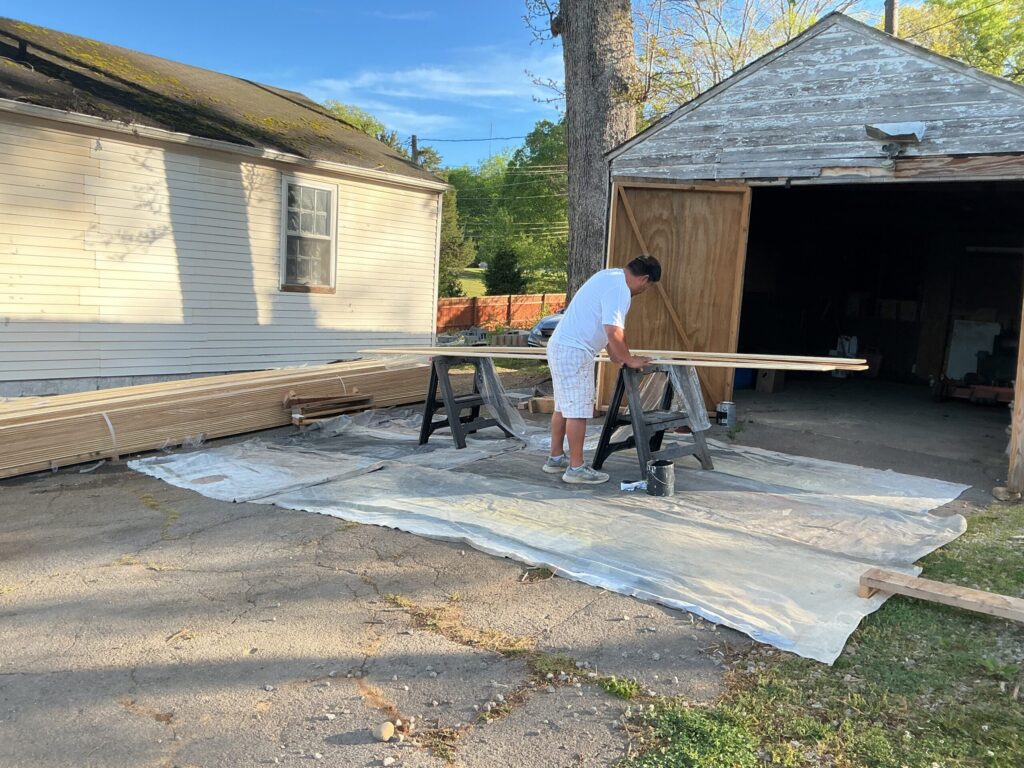
Plenty of sheds look perfectly respectable from the yard while the material doing the actual work has been quietly deteriorating.
The layer that usually goes first is the sheathing — the OSB or plywood under the siding and under the roof covering. It is hidden on both faces, so it can be soft, delaminating or crumbling at the edges while the painted surface outside still looks sound. The same is true of the bottom plate and the floor framing, which sit closest to the ground and dry out the slowest.
Inside the building the signs are easier to read if you know where to look: dark staining on the underside of the roof sheathing, daylight at a roof-to-wall junction, a floor that flexes near one wall, swelling or separation at the bottom edge of a wall panel, or a door frame that has moved enough to stop the door latching.
That is why the correct repair cannot be settled from a photograph. It depends on what is found once the damaged material is opened up, and the written scope says what happens if the condition turns out to be worse than it looked.
Shed damage does not stay where it starts, because the thing causing it does not stop.
A roof leak wets the sheathing, then the framing under it, then whatever is stored below. Siding that has gone soft at the bottom stops protecting the framing behind it, and the damp moves sideways along the base of the wall. A door that no longer closes square leaves a gap that lets weather and animals in.
The practical cost of waiting is that the repair changes category. Replacing a run of siding and some trim is a straightforward job. Replacing the framing and floor behind that siding because it sat wet for two more seasons is a much bigger one.
That is the reason we would rather look at it while the damage is still boring.
We diagnose first, explain what is actually damaged, and recommend the amount of work the structure truly needs.
Not every exterior project is a full replacement. Sometimes a homeowner needs one damaged board replaced, a small section rebuilt, a leaking shed roof corrected, a rotten post repaired, or a small structure improved. MI Homesiding approaches those projects with the same attention to diagnosis, moisture control, structural condition, and workmanship as larger exterior projects.
MI Homesiding is owner-led. Mel Hernandez brings 20+ years of hands-on construction and exterior remodeling experience, including finish carpentry, and that background is the reason we can look at damaged wood, framing, trim, siding, sheathing and posts and judge what is still sound instead of assuming the whole structure has to go.
We are willing to evaluate both small repairs and larger replacement projects. A shed repair is often the kind of job homeowners find hard to get someone to come out for, and it is work we are glad to look at.
Find the cause, not the stain.
We look at the roof edge, the openings, the bottom of the siding and the ground around the building before deciding what to replace.
Work out how far it has gone.
Surface damage and structural damage are different jobs, and the difference is usually behind the siding.
Put the scope in writing.
What is being replaced, what is being left, and what we will do if it turns out to be worse once it is open.
Open it up and check.
Removing the failed material is when the real condition becomes visible. Anything concealed gets documented before it is covered.
Repair and re-detail.
New material goes on with the detail that stops it happening again, rather than the one that caused it.
Walk it with you.
What we found, what we changed, and what to keep an eye on.
If concealed rot or damage is discovered during the project — such as deteriorated framing, sheathing, posts, or other supporting components — MI Homesiding will document the condition and issue a written Change Order for any additional repair that is required and approved. We do not knowingly cover concealed deterioration with new materials or finishes.
On shed repairs this is the normal course of events rather than the exception, because the damage is usually behind the material that has to come off first. It is why the written scope says what happens if the condition is worse than it looked.
If only one section is damaged, the recommendation does not automatically have to be a full rebuild. When practical, MI Homesiding can isolate the damaged area, remove the failed material, inspect what is behind it, and repair only the affected portion.
In practice that means replacing a run of siding rather than re-cladding the building, rebuilding one wall rather than four, replacing a section of floor sheathing rather than the whole floor, or correcting one roof edge rather than recovering the roof.
We will not promise that a localized repair is always possible. Whether it is depends on how far the damage has travelled, and that is usually only visible once the failed material is off. What we can promise is that we will look before we decide, and tell you what we found.
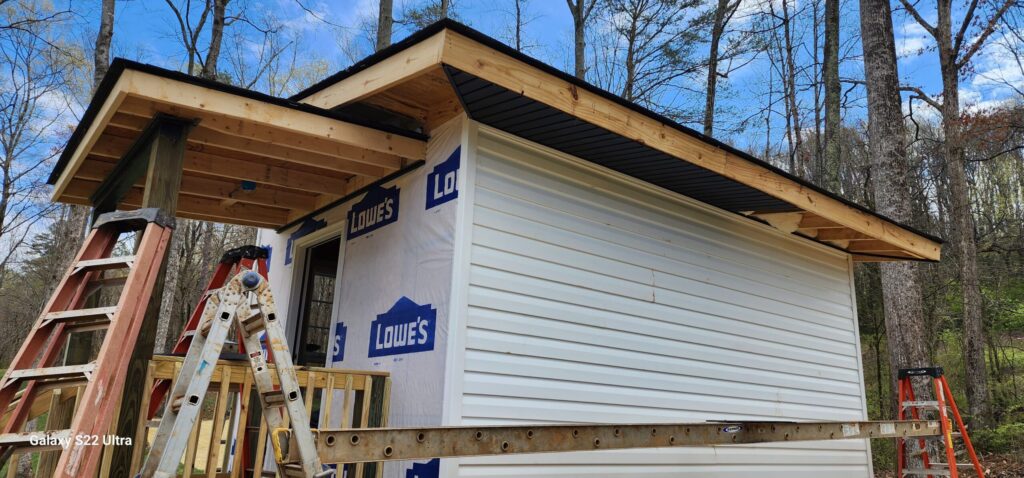
We will tell you which side of the line your building is on, and we would rather do the smaller job if the smaller job will hold.
Repair usually makes sense when the floor and the wall framing are still sound, the damage is in the covering — roofing, siding, trim, a door — and the cause is something that can be corrected, like an edge detail or where the roof puts its water.
More extensive replacement starts to make sense when the floor framing has gone soft across a large area, when several walls have structural damage rather than surface damage, when the roof structure itself is involved, or when the parts that would need replacing add up to most of the building.
There is also a middle option that gets forgotten: partial replacement. Rebuilding one wall, or a roof, or a floor section, on a building that is otherwise fine is often the right answer and is far cheaper than starting again.
If it does turn out to be past saving, we would build the replacement the same way — see shed construction.
Many localized shed repair projects fall between $550 and $2,000. Final pricing depends on the damaged components, how much material must be removed, what is found underneath, access, materials, and the final approved scope.
That is a planning range, not a quote. Some repairs are smaller than it. Some sheds turn out to need more than it once the failed material is off, and when that happens it is handled through the written Change Order process described above rather than as a surprise at the end.
What moves the number, in rough order of how much it matters: how many separate components are involved, whether the damage is only in the covering or has reached the framing and sheathing, how much has to be removed to reach it, and whether a finish is being applied afterwards.
You get the figure in writing, itemized, after we have looked at the building.
Shed repair sits in an awkward gap. Small shed repairs can be difficult for homeowners to get evaluated, especially when the problem involves both wood damage and water intrusion. The thing that caused it is usually a detail at a roof edge, an opening or the bottom of a wall.
That gap is the work we already do every day on houses: roofing, siding, trim, flashing and rot repair. A shed is the same set of problems at a smaller scale, with more edges per square foot of wall.
Practically, that means we diagnose before quoting, we tell you what can stay, we put the scope in writing, and we show you what we found when it is open. The work is performed under MI Homesiding’s responsibility, with the scope documented and the completed work reviewed against the agreed project requirements.
Some shed repairs we are called to have already been repaired once. Someone has already replaced the rotten board, and it has rotted again, because the reason it rotted was never addressed.
The usual culprits are the bottom edge of the siding sitting too close to wet ground, a roof that drops its water right against the base of the wall, and openings that were never properly detailed. New material on top of any of those is a temporary result.
It is the same principle as rotted siding and trim repair on a house, and the same reason we look at roofing details when the complaint is about a wall.
Where a repair is finished with paint or stain, the preparation matters as much as the coating — the same approach as our exterior painting work.
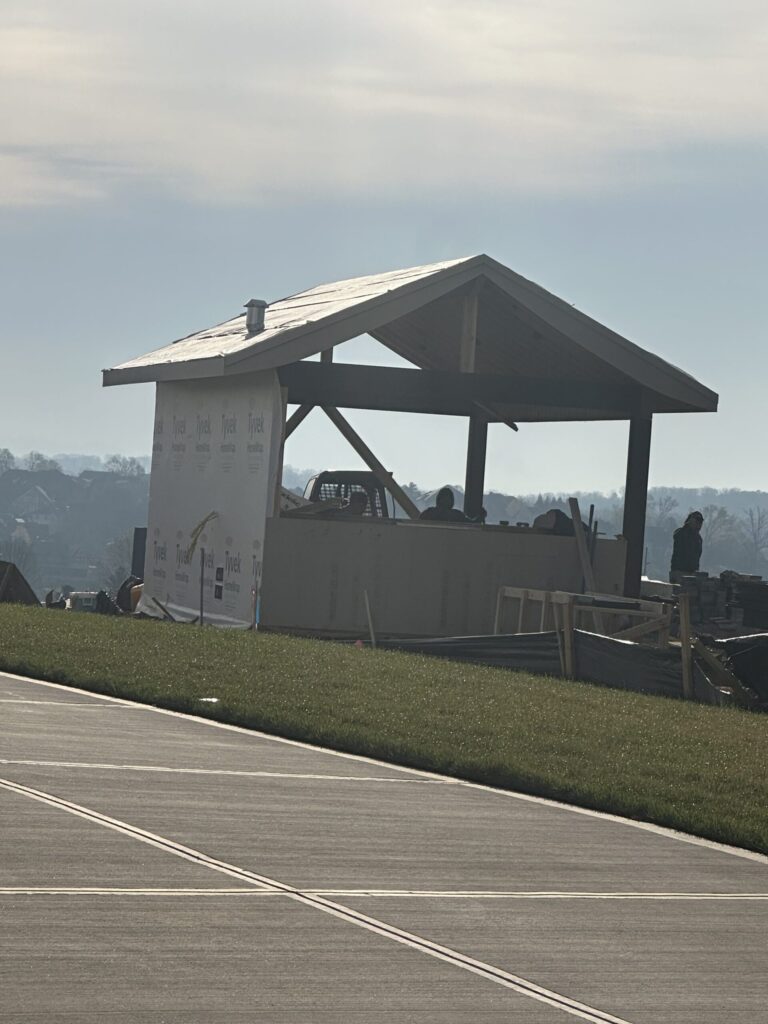
MI Homesiding serves homeowners in Knoxville and surrounding East Tennessee communities, including Maryville, Alcoa, Farragut, Oak Ridge, Clinton, Powell, Lenoir City, Seymour, Sevierville, Pigeon Forge, Gatlinburg, Dandridge, Jefferson City, Halls Crossroads, Norris, and Louisville. If you are outside one of these areas, contact us and we can confirm whether your property is within our current service area.
The full list is on our service areas page.
We are a service-area business and travel to the property. The map shows the area we cover rather than a walk-in location.
Usually, if the floor and the wall framing are still sound. When the damage is in the roofing, siding, trim or a door, those are replaceable parts on a building that is still structurally honest. We will tell you if it is not.
Yes. T1-11 tends to fail at the bottom edge and around fasteners. Sometimes a section can be replaced; sometimes the wall is better re-clad. What matters either way is correcting whatever kept it wet.
That is the normal situation, because water rarely appears where it gets in. We look at the roof edges, any penetrations, and where the roof hands its water off, rather than guessing from the stain inside.
Yes. A door that has dropped or gone out of square is often telling you something about the framing or the floor underneath it, so we look at the cause before rehanging anything.
Yes — wind damage to roofing, limb strikes, and walls or doors pushed out of line. We document what we find, with photographs. How an insurer handles a claim is between you and your carrier, and not something we can speak for on their behalf.
Yes, and it is often the right answer. Partial replacement on a building that is otherwise sound is a real option and usually much cheaper than starting again.
Electrical and plumbing work, grading or drainage work beyond the immediate area, and full rebuilds are handled separately when they apply. The written scope lists what is included and what is not.
Tell us what the shed is doing — the leak, the soft floor, the door that will not shut — and we will come and look at it. If a repair will hold, that is what we will quote.